19 Feb

Down Payment Rules in Ontario: What Every Home Buyer Should Know

General

Posted by: Tracey Brock

Down Payment Rules in Ontario: What Every Home Buyer Should Know

If you are reviewing down payment rules in Ontario, clarity matters. Across the Greater Toronto Area, the same question appears repeatedly.

Is twenty percent required?

In most cases, it is not.

Under current federal guidelines, properties priced below $1.5 million may qualify with less than twenty percent down payment, subject to mortgage default insurance requirements. As a result, understanding the updated thresholds prevents unnecessary over-saving.

Let us break this down clearly.


How Down Payment Rules in Ontario Work

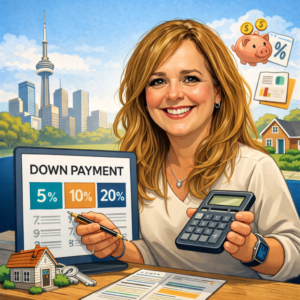
Currently, Canada uses a tiered minimum down payment system. This structure applies to all buyers, not only first-time purchasers.

Here is how the percentages apply:

  • Five percent on the first $500,000

  • Ten percent on the portion between $500,000 and $1,499,999

  • Twenty percent minimum at $1.5 million or more


The $1.5 Million Threshold in Ontario

Previously, insured mortgages were capped at $1.0 million. However, the federal limit increased to $1.5 million. Consequently, more properties in the GTA now qualify for insured financing.

To illustrate:

Purchase price: $900,000

Five percent of $500,000 equals $25,000.
Ten percent of $400,000 equals $40,000.

Total minimum down payment equals $65,000.

Now compare that with a $1,500,000 purchase.

Minimum down payment equals $300,000.

Clearly, the threshold creates a significant capital shift. Therefore, purchase price strategy directly affects required liquidity.


Real GTA Math Examples

Example 1: $800,000 purchase

5% of $500,000 = $25,000
10% of $300,000 = $30,000
Minimum down payment = $55,000

Example 2: $1,200,000 purchase

5% of $500,000 = $25,000
10% of $700,000 = $70,000
Minimum down payment = $95,000

This example is exactly why the $1.5M cap matters in the GTA. A buyer no longer needs $240,000 down simply because the price is above $1.0M.

Example 3: $1,499,999 purchase

5% of $500,000 = $25,000
10% of $999,999 = $99,999.90
Minimum down payment = $124,999.90

Example 4: $1,500,000 purchase

Minimum down payment = $300,000
Mortgage default insurance not available.


Buying With Less Than Twenty Percent

A down payment below twenty percent triggers mortgage default insurance. In this structure, the insurance premium is added to the mortgage balance.

Although insurance introduces additional cost, insured mortgages often receive competitive interest rates due to reduced lender exposure. Consequently, insured status should not be viewed negatively without analysis.

For a deeper structural comparison, see Insured vs Uninsured Mortgage in Ontario.


Aligning Down Payment With Qualification

Minimum capital represents only one component of approval. Qualification criteria remain separate.

Income stability, debt ratios, credit profile, stress test requirements all influence borrowing power.

Because of this, savings plans must align with qualification strength. Before transferring funds between accounts, review the Mortgage Pre-Approval Process in Ontario. to ensure timelines remain aligned.

For first-time buyers structuring registered accounts, see  First Time Buyer Down Payment in Ontario for a strategic breakdown.


Common Misunderstandings

Many buyers assume twenty percent is mandatory.

Some believe the older $1.0 million cap still applies.

Others move funds too close to closing.

Each mistake creates friction.

Clarity prevents delay.


Final Thought

Down payment rules in Ontario follow a clear framework.

The insured threshold now reaches $1.5 million.

Knowing the tiers protects your capital strategy.

Clarity reduces stress. Structure builds control. Planning strengthens every offer.

Mortgage Strategy in Your Pocket

Planning does not stop after reading one article.

Download the app to:

• Calculate payments
• Test affordability scenarios
• Compare mortgage options
• Stay organized through approval
• Track your purchase or refinance in one place

Download the app here:
https://www.dlcapp.ca/app/tracey-brock?lang=en
Tracey Brock * 416.788.6207 * TBrock@DominionLending.ca * DLC Expert Financial 12129 * Independently o/o

19 Feb

Using your RRSP, FHSA, the Home Buyers’ Plan should be intentional — not reactive.

General

Posted by: Tracey Brock

If you’re trying to understand the first time buyer down payment in Ontario, you’re not alone — especially in the Greater Toronto Area where home prices make planning essential knowing the difference between FHSA vs RRSP for first-time home buyers in Ontario is a great place to start.

Between higher home prices, qualification rules, and rising living costs, most first-time buyers don’t have room for financial missteps. Yet we still see the same pattern: an offer gets accepted, then the questions start.

“How do we pull money from our RRSP?”
“Can we use the FHSA too?”
“Are there tax consequences?”

Your RRSP, FHSA, the Home Buyers’ Plan should be used intentionally — not reactively.

Because timing matters, it’s smart to structure this before you start house hunting.

If you’re already thinking about buying, you can start your mortgage application here and we’ll review your FHSA and RRSP strategy as part of the process:
https://velocity-client.newton.ca/en/client/journey/home?shortCode=kg2f5wh1spba


First Time Buyer Down Payment: Quick Ontario Overview

If you want the short version:

  • FHSA: Tax-deductible contributions, tax-free withdrawal for a qualifying first home, no repayment required.

  • RRSP (Home Buyers’ Plan): Tax-free withdrawal upfront, but repayment required over 15 years.

  • Typical Strategy: Use FHSA first. Layer in RRSP if needed.

Now let’s break it down properly.


Understanding the First Time Buyer Down Payment in Ontario

The FHSA (First Home Savings Account)

The FHSA gives you:

  • Tax-deductible contributions

  • Tax-free withdrawals for a qualifying first home

  • $8,000 annual contribution room

  • $40,000 lifetime maximum


The RRSP and the Home Buyers’ Plan (HBP)

The RRSP works differently. Specifically, it connects to the Home Buyers’ Plan.

Under the Home Buyers’ Plan:

  • You can withdraw up to $60,000 from your RRSP

  • The withdrawal is tax-free at the time

  • However, you must repay it over 15 years

If you miss a repayment, as a result, the missed amount becomes taxable income.

Therefore, while the RRSP can be helpful, that repayment obligation is exactly why planning ahead matters.


How the First Time Buyer Down Payment Works in the GTA

Let’s bring this into real numbers.

Example purchase: $850,000 condo in Toronto.

Minimum down payment required:

  • 5% on first $500,000 = $25,000

  • 10% on remaining $350,000 = $35,000

Total minimum down payment = $60,000

Understanding the minimum down payment structure is critical in Ontario. If you want a full breakdown of how the percentages work at different price points, read our guide on how much down payment first-time home buyers need in Ontario.

Now imagine you have:

  • $20,000 saved in your FHSA

  • $40,000 available in your RRSP

Strategic approach:

  • Withdraw $20,000 from FHSA (no repayment required)

  • Withdraw $40,000 under the HBP (structured repayment)

Depending on your down payment size, your mortgage may be classified differently. Here’s a breakdown of insured vs uninsured mortgages in Ontario and how that affects rates and qualification.

When structured properly, there’s no scrambling, no unexpected tax issues, and no last-minute financial stress.


Planning Your First Time Buyer Down Payment 12–24 Months Ahead

The strongest first-time buyers in the GTA don’t wait until an offer is accepted.

They plan 12–24 months in advance.

That means:

  • Opening FHSA accounts early

  • Timing RRSP contributions for tax efficiency

  • Reinvesting refunds intentionally

  • Aligning savings strategy with qualification strategy

Before you move money between accounts, it also helps to understand the mortgage pre-approval process in Ontario, so your savings strategy aligns with your qualification timeline.

Savings and qualification should work together — not separately.


Case Study: York Region First-Time Buyers

Mark and Sara live in Vaughan. Combined income: $150,000.

Instead of rushing, they planned 24 months ahead. As a result, their savings strategy was structured instead of rushed.

First, their FHSA contributions totaled $32,000.
Then, they reinvested the tax refunds.
In addition, they structured their RRSP contributions strategically.

FHSA Contributions

  • $32,000 combined over two years

  • $9,000–$10,000 in tax refunds

They reinvested the refunds.

RRSP Contributions

  • $50,000 total

  • Approximately $14,000 in additional refunds

By the time they purchased, their total down payment strength was over $105,000.

They bought confidently without borrowing from family and without draining emergency savings.

That’s what structured planning looks like in the GTA.


Common Mistakes We See in Ontario

  1. Waiting until after an accepted offer

  2. Overfunding RRSP while ignoring FHSA

  3. Not planning HBP repayment

  4. Missing contribution deadlines

  5. Moving funds too close to closing

In a competitive market like the Greater Toronto Area, these mistakes can cost thousands — or delay a purchase altogether.


FAQs

Should I use FHSA or RRSP first as a first-time home buyer in Ontario?
In most cases, the FHSA should be maximized first because it does not require repayment.

Can I combine FHSA and RRSP for the same purchase?
Yes. Many GTA buyers use both together to reach their required down payment.

Do I repay FHSA withdrawals?
No. Qualified withdrawals are tax-free and do not require repayment.

What happens if I miss an HBP repayment?
The missed amount is added to your taxable income for that year.

How early should I plan this strategy?
Ideally 12–24 months before you intend to buy.


Final Thought

In the GTA, saving money isn’t enough.

Structuring it properly is what changes outcomes.

If you’re planning to buy within the next 6–24 months, let’s map out your FHSA and RRSP strategy before you make an offer.

Planning first. Offers second.

Take the strategy with you.
Download the app to calculate payments, review affordability, and stay aligned with your mortgage plan.

https://www.dlcapp.ca/app/tracey-brock?lang=en

First time buyer down payment in Ontario

Tracey Brock * 416.788.6207 * TBrock@DominionLending.ca * DLC Expert Financial 12129 * Independently o/o